Handling day shouldn't feel like a near miss every time.
If you're running two to ten cattle on a lifestyle block, you've probably wrestled with this: commercial yard setups look overbuilt and expensive, but doing things ad hoc with a makeshift gate and a prayer isn't working either. A cattle yard for a small herd sits in a frustrating gap in the market, and most of the advice out there is either written for 500-head operations or so vague it's useless.
This post is for farmers who are serious about their stock, even if their herd fits in a single paddock. We'll walk through what a micro-herd yard actually needs, where people go wrong, and how to spec a setup that's practical, safe, and built to grow with you.
Why Small Herds Still Need a Proper Yard
There's a temptation to think that with only a handful of cattle, you can manage without dedicated infrastructure. And for a while, you can. But that logic falls apart the first time you need to drench, pregnancy-test, or get a sick animal into a crush on your own.
The stakes don't scale down with your herd size. A 500kg Angus doesn't care how many siblings it has. It's still strong, still unpredictable under stress, and still capable of doing serious damage to you, itself, or a poorly designed gate.
Solo handling is where this gets real. Most content about cattle yards assumes there are two or three people on the job. For a lot of lifestyle block farmers, that's not the reality. You need a yard designed around how you'll actually use it, not how a commercial operation would.
The Biggest Design Mistake Small-Scale Farmers Make
Overbuilding is one trap. But underbuilding is more common, and it causes more problems.
The typical approach for a small herd goes something like this: a few portable panels assembled into a loose pen, a crush bolted to a fence, and a makeshift race that's too wide, too short, or both. It looks functional enough until cattle start turning around in the race, or you're trying to draft a single animal, and everything descends into chaos.
The core issue is that people design for capacity instead of flow. A yard that holds ten cattle comfortably is useless if the animals can't be moved through it in a controlled, low-stress way. Good cattle handling at any scale is about directing movement, not containing force.
This is where Temple Grandin's work becomes genuinely useful, even for micro-herds. Cattle move better when they can't see what's ahead of them, when they're not pressured from behind by noise or sudden movement, and when the handling system works with their natural instincts rather than against them. These principles don't require a large footprint. They require thoughtful design.
What a Functional Cattle Yard for a Small Herd Actually Needs
Strip it back to the basics, and a working yard for two to ten cattle needs to do four things well.
Hold stock calmly before handling. A holding pen with solid or semi-solid sides reduces visual distraction and keeps cattle quieter. This is more important than pen size. Calm cattle are easier to handle alone.
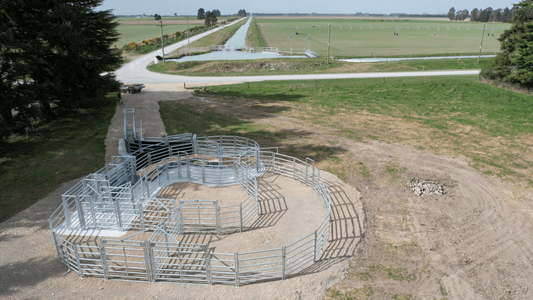
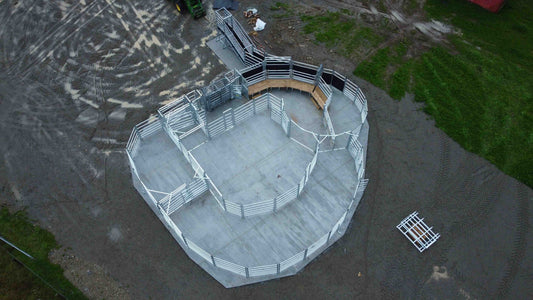
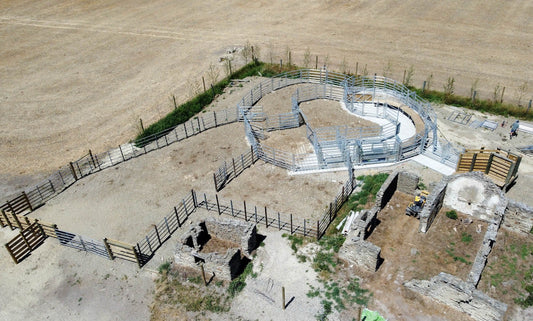
Move animals into a race without drama. A forcing pen that curves naturally into the race works far better than a straight funnel. Circular forcing pen designs, even compact versions, are worth considering here. They use cattle's instinct to circle back and work with it.
Restrain one animal safely. A good crush is non-negotiable. For a micro-herd, you're not looking for an industrial squeeze race. You need something sized appropriately, with reliable head bail operation and enough clearance to work around the animal without risk. Even occasional use, once or twice a year per animal, justifies getting this right.
Load cattle onto a vehicle. A loading ramp completes the picture. Without one, getting cattle onto a truck or trailer means improvising every single time, which is where accidents happen.
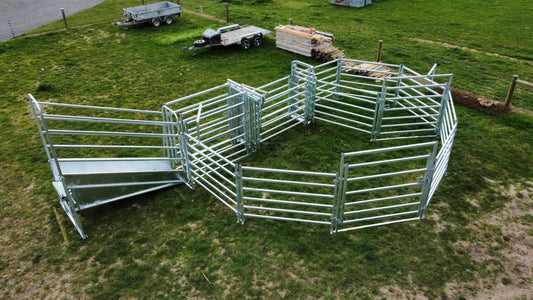
That's the minimum viable yard. Holding pen, forcing area, race, crush, and ramp. Everything else is optional until you need it.
Thinking About Footprint and Orientation
Space is usually a real constraint on a lifestyle block. The good news is that a functional yard for a small herd doesn't need much of it.
A compact setup for up to six head can fit into a surprisingly tight space if it's laid out well. The key is orientation relative to your main access track, your paddocks, and your loading area. Cattle should flow naturally through the yard in one direction without backtracking or doubling back. Every 90-degree turn adds friction. Every dead end adds stress.
Ideally, cattle should enter from a familiar direction, ideally from where they're used to coming for feed. They should flow into the forcing pen, through the race, and either into the crush or up the ramp without confusion. The handler should be able to move between positions without crossing the cattle's path.
Think about where you'll park a ute or trailer when loading, where you'll stand when operating the crush, and where the exit takes cattle after treatment. Walking through these scenarios before any panels go in saves a lot of frustration later.
Sun and wind are worth factoring in too. Cattle are calmer when they're not facing into bright light or walking into a strong southerly. Orienting the race to avoid this where possible is a small thing that pays off on handling day.
Building for Now, Expanding for Later
One of the most practical things you can do with a small herd setup is design for expansion from the start, even if you don't build everything at once.
A phased approach works well here. Start with the core handling area: a holding pen, a short race, and a crush. Get that right and working. Add a second holding pen or a drafting gate when you need it. Extend the forcing pen if your herd grows beyond six or eight head.
Panel-based systems make this straightforward. Modular yards can be reconfigured as your operation changes, which matters a lot if you're on leased land, if your stocking numbers vary seasonally, or if you're not yet sure how your property will develop.
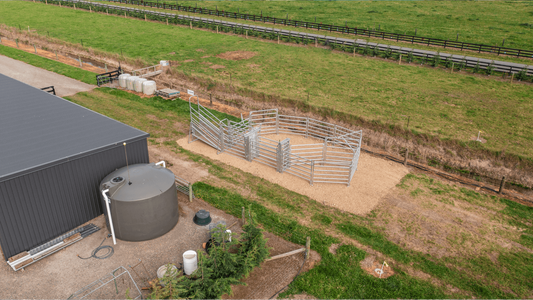
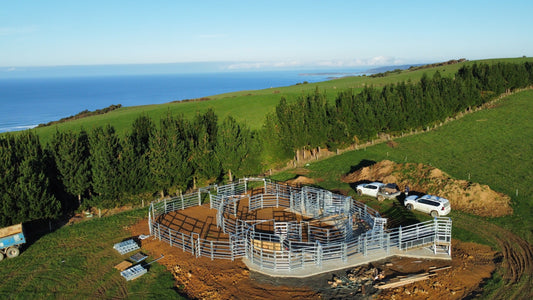
The Onefarm MAXXUS range is built with exactly this kind of flexibility in mind. It's designed for lifestyle blocks and smaller operations, with panels and components that can be added to over time. You're not locked into a fixed configuration, and you're not paying for infrastructure you don't need yet.
What to Look for in Panels and Crush
Not all panels are built the same, and with a micro-herd, your handling infrastructure takes a higher rate of use per animal than a large commercial yard would. When every job means running the same five animals through the same setup, the quality of the components matters.
Strength in a cattle panel doesn't come from steel thickness alone. Rail profile depth is what actually resists the lateral load a cattle applies. Onefarm's 47mm deep cattle rail is 15% stronger than most alternatives for exactly that reason. It's a detail that matters less when you're counting animals in the hundreds and more when the same few cattle are going through your race regularly.
Hot-dipped galvanising is worth specifying, not just powder coating. The difference becomes obvious after a few winters in a wet paddock corner. A galvanised finish bonds to the steel at a molecular level and will outlast a coated finish considerably, particularly in high-wear contact points.
For the crush, look for a clean head bail action and a design that doesn't create noise or sudden movement when it operates. Nervous cattle respond badly to clanging metalwork. It sounds like a small thing until you're standing next to a stressed animal in a confined space.
You Don't Need to Figure This Out Alone
Designing a cattle yard for a small herd is more considered work than it might seem. Getting the layout wrong means every handling day is harder than it needs to be. Getting it right means one person can safely and calmly work a small mob without drama.
The MAXXUS range from Onefarm is priced and sized for operations like this, with a 6-head yard available at great value compared to similar setups elsewhere in the market. If you're not sure where to start or what configuration suits your block, flick us a message or give us a call. There's a Kiwi on the other end who knows cattle yards, and we're happy to talk through what actually makes sense for your setup.
For farms big and small, a well-designed yard is one of the most practical investments you'll make. And for a small herd, it might just be the thing that makes handling day something you can manage on your own, calmly and safely, every time.