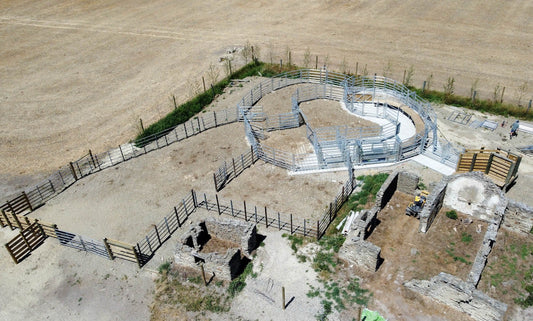
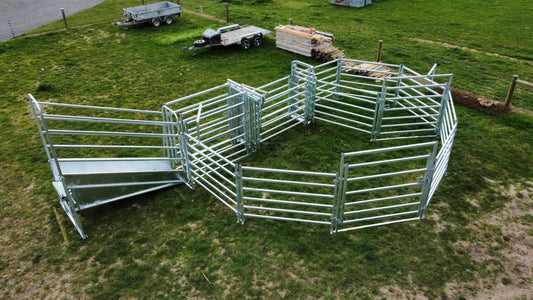
An undersized yard doesn't just slow you down. It stresses your cattle, creates serious injury risk for the people working in it, and quietly eats into your margins every time you use it.
Getting cattle yard sizing right before you build is one of the most valuable decisions you'll make on your farm. Build too small, and you're fighting your infrastructure from day one. Build smart, and your yards will work with you for decades.
This guide covers how to think about yard capacity, what factors actually drive the numbers, and how to make sure what you build today still fits the operation you're running five years from now.
Why Getting the Size Wrong Costs More Than You Think
Most farmers build yards once. That's not pessimism, it's just reality. Steel, concrete, and ground preparation add up, and most people aren't keen to do it twice.
The problem is that sizing decisions made on today's herd numbers can quickly become a constraint on tomorrow's operation. A 50-head yard for a 50-head herd sounds logical until you factor in working space, race flow, and the reality that you rarely work all your cattle at exactly the same time.
And when yards are too tight, the risk climbs fast. Cattle under pressure behave unpredictably. They'll push back, bunch up, and take the path of least resistance, which sometimes means through a gate, over a rail, or into whoever's standing nearby. Undersized yards aren't just an efficiency problem. They're a safety problem for your stock and for you and your team.
On the flip side, massively oversized yards can be just as problematic in a different way. Cattle in a pen that's too large are harder to move, harder to direct, and harder to handle with a small crew.
The goal is a yard that fits.
Start With Your Working Herd, Not Your Total Numbers
The first number you need isn't your total herd size. It's your working herd: the maximum number of cattle you'll ever need to hold and process in a single session.
For a lot of farmers, that's a subset of the total. You might run 300 heads but only ever process 80 to 100 at a time. Or you might draft your whole mob through in one go. Knowing which applies to your operation is the starting point for every other sizing decision.
A general rule of thumb used across the industry is approximately 1.5 to 2 square metres per adult beast in a holding pen. That's working space, not packed-in space. Cattle need enough room to stand comfortably, turn slightly, and move without the pen becoming a pressure cooker.
For a practical example, a pen designed to hold 30 adult cattle comfortably needs somewhere in the range of 45 to 60 square metres of usable floor space.
But holding pen size is only part of the equation.
Cattle Yard Sizing: The Components That Actually Matter
When people talk about sizing, they often focus only on the main holding pen. In practice, yard capacity depends on the whole system working together.
Forcing pen
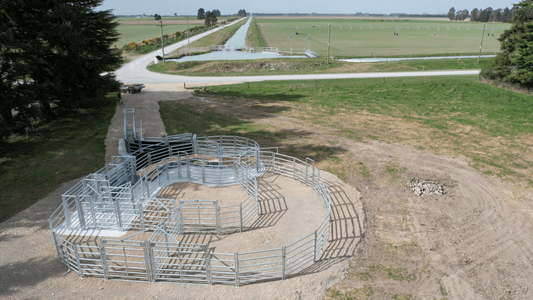
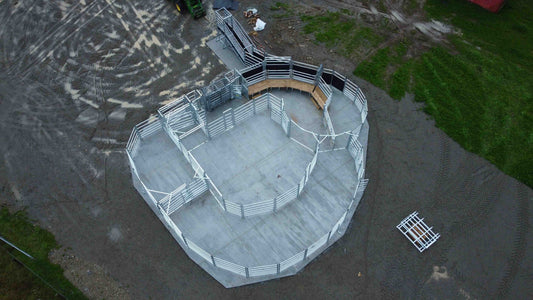
The forcing pen is where cattle queue before entering the race. If it's too large, the cattle spread out and won't push forward. If it's too small, you're constantly moving cattle around to keep the flow going. A well-sized forcing pen holds roughly 8 to 12 heads and tapers toward the race entrance to keep movement natural and low-stress.
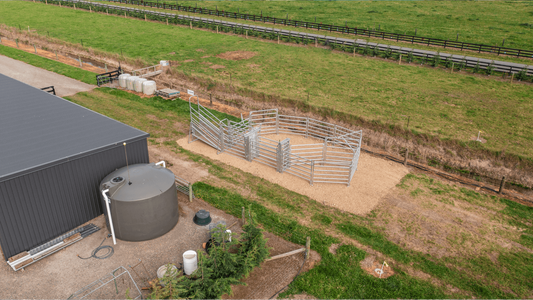
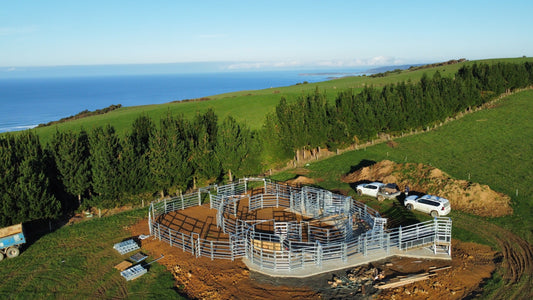
A circular forcing pen takes this further. The curved design encourages cattle to follow the inside edge, which works with their natural tendency to circle. This reduces the pressure you need to apply and improves flow significantly, particularly for larger mobs.
Race length and width
Race width for beef cattle is typically 700mm to 750mm. Too narrow and cattle struggle; too wide and they can turn around, which creates handling problems fast. Race length should comfortably hold enough cattle to keep the crush working without the operator constantly refilling mid-session.
Drafting space
If you're running any volume of cattle through your yards regularly, a drafting area isn't a luxury. It's a practical necessity. Sizing this correctly means thinking about where drafted cattle go and how many separate pens you realistically need to hold different mobs.
Loading ramp
If you're loading cattle onto trucks for transport, ramp dimensions matter. Standard truck deck heights vary, and a ramp that doesn't match your transport setup creates a bottleneck every time you load. This is a detail that's easy to get right at the design stage and surprisingly inconvenient to fix afterwards.
Herd Type Changes the Numbers
Beef cattle and dairy cattle move differently. Larger breeds like Hereford-Friesian crosses or Angus need more linear space in a race than lighter breeds. Younger stock can be more reactive and need slightly more holding pen space relative to their number because they're less predictable.
Cows with calves at foot are a separate consideration entirely. You need enough pen space to keep pairs together or to separate them without chaos.
If you run a mixed operation with varying ages and classes, think about your system in terms of the most demanding scenario you'll face, not the average. That's your sizing benchmark.
Future-Proofing Without Overshooting
There's a balance between building for growth and building for a herd you may never have.
A practical approach is to size your holding pen for 20 to 30 per cent above your current working herd and make sure your site preparation and layout allow for additional pen space to be added later without rebuilding the core structure from scratch.
That way, you're not paying now for steel you don't need yet, but you're also not boxing yourself in.
Thinking about the race, crush, and loading ramp as fixed infrastructure and the holding and drafting pens as expandable infrastructure is a useful way to frame it. The core working components should be sized for your realistic five-year operation. The surrounding pens can grow with you.
Lifestyle Block Sizing vs. Commercial Operations
Not every farm needs a 200-head system.
For lifestyle block farmers running 10 to 30 head, a well-designed compact yard does the job cleanly. The MAXXUS range exists for exactly this reason. These yards are built with the same structural thinking as larger commercial yards, but sized for the reality of a smaller operation: occasional handling for drenching, pregnancy testing, or moving cattle between paddocks.
A 6-head yard works well if you're running 3 or 4 cattle and need to handle them a few times a year. Step up to a 10 to 15-head configuration if you're processing stock more regularly or working alone and need the extra holding capacity to manage safely by yourself.
At the commercial end, the calculation shifts. High-frequency use, larger crew handling, and the demands of processing big numbers in a single session mean that ergonomics, flow efficiency, and component quality carry more weight in the overall decision.
In both cases, the principle is the same: build for how you actually farm.
Don't Forget the Handler
Stock handling facilities are assessed not just on cattle flow but on handler safety. A yard that moves cattle efficiently but puts your team in compromised positions isn't a well-designed yard.
Walkways alongside races need to give the operator a clear sightline and a safe exit route. Pen gates should swing wide enough to allow a person to move quickly if needed. Crush positioning should mean the operator isn't reaching into the race from an awkward angle.
These details come down to thoughtful design and the right components, but they also come down to sizing. Cramped yards mean cramped workers. Give your team room to do their job properly.
Get the Right Yard for Your Setup
Onefarm offers Cattle Yards for farms big and small, from compact MAXXUS configurations for lifestyle blocks through to full Commercial yard builds for high-volume operations.
If you're not sure where to start, flick us a message or give us a call at 0800 ONEFARM. There's a Kiwi on the other end who knows yards and will give you a straight answer. We'll work through your herd size, your site, and your handling needs and help you figure out what actually fits.
Build it right once. That's the goal.