Every time your cattle baulk at the race entry, you lose time. Every time they scramble and pile up in the forcing pen, you risk injury. And every time you walk away from a muster red-faced and worn out, you're probably blaming the cattle.
More often than not, the yards are the problem.
This is an opinion, and here it is plainly: most cattle handling problems in New Zealand are a yard design issue dressed up as an animal behaviour problem. The cattle aren't being difficult. They're responding rationally to an environment that's working against them.
If you're serious about animal welfare, handler safety, and protecting your returns, it's worth understanding what's actually happening in your cattle yards and why a few design decisions make all the difference.
What Stress Actually Costs You
Before we talk about design, let's talk about money. Stressed cattle don't just make your morning miserable. They bruise. They lose weight. They spike cortisol levels that affect meat quality. They injure themselves and, sometimes, the people handling them.
Bruising alone can mean significant carcase downgrades at the works. Weight shrinkage from a rough muster can knock kilograms off animals you've spent months growing. Then there are the vet bills, the near-misses, and the slower processing times that quietly erode a day's margin.
None of that shows up on a single line in your accounts. It's spread across a dozen smaller losses that add up over a season. The cost of well-designed cattle yards looks a lot more reasonable when you factor all of that in.
What Cattle Actually See (And Why It Matters)
Temple Grandin's research changed how the livestock industry thinks about handling. Her core insight, one that still gets ignored in countless yard setups across the country, is that cattle are prey animals with wide-angle, panoramic vision and a strong sensitivity to contrast, movement, and unfamiliar objects.
They're not being stubborn when they refuse to enter a race. They're seeing something that triggers a flight response. A shadow across the entry. A jacket hung on a rail. A patch of bright sky at the end of a dark tunnel. These things look, to a cow, like a potential threat.
Designing with this in mind isn't complicated. It just requires thinking from the animal's point of view rather than the handler's.
The Design Features That Reduce Anxiety
Here's where practical advice meets opinion. These aren't industry talking points. They're the things we've seen make a genuine difference on farms from Northland to Southland.
Curved races outperform straight ones
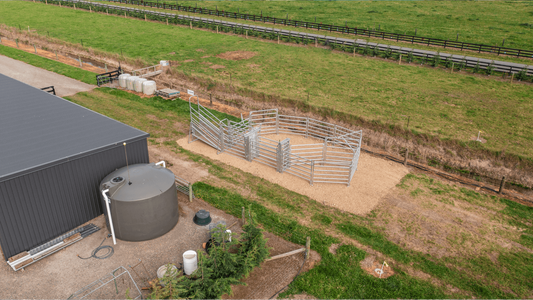
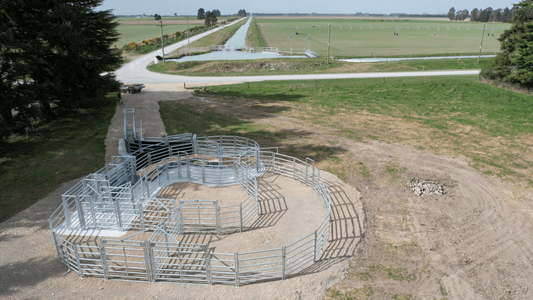
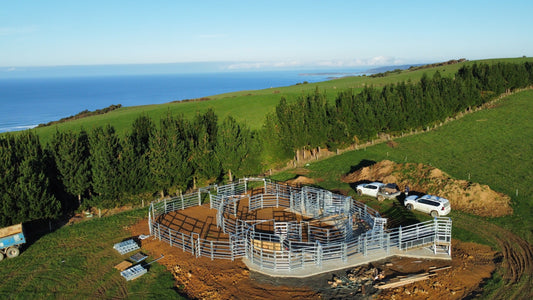
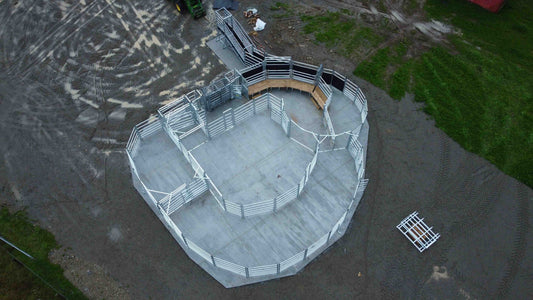
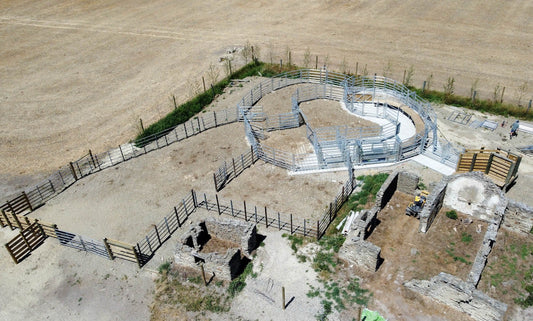
Cattle move better when they can't see what's ahead. A curved race exploits their natural tendency to move in an arc and limits their line of sight to the next few animals. Straight races let them see the full length of the facility, including the crush, the handler, and anything else that might cause them to dig in.
If you're building new cattle yards or planning a retrofit, a curved race isn't a luxury. It's one of the highest-value changes you can make.
Solid fencing at key points
Solid panels in the forcing pen and along the race reduce visual disturbance from outside the yard. Cattle in a forcing pen will often spin or baulk because they can see movement through the rails. A dog. A person walking past. A vehicle. Solid sides eliminate that distraction.
Full solid panels aren't always practical everywhere. But in the areas where you're asking cattle to commit to a direction, solid fencing does real work.
Lighting that doesn't spook
Shadows are the enemy. A sharp contrast between a dark race and a bright sky at the far end is enough to stop cattle dead. The fix is usually straightforward: orient your yards to avoid direct sun angles at race entries, use diffused or consistent lighting throughout, and think carefully about where shadows fall at different times of day.
Cattle move from dark to light naturally. Design with that tendency and you stop fighting them.
Noise reduction matters more than most farmers realise
Clanging metal, rattling gates, and the sharp crack of a slam all send stress signals through a mob. Rubber buffers on gates, properly fitted latches, and rails that don't vibrate under pressure make a quieter yard. A quieter yard is a calmer yard.
This is one area where material quality pays back directly in animal behaviour. Yards that are built to tight tolerances simply make less noise in operation.
Surface and footing
Cattle that slip lose trust in where they're standing. Once an animal loses footing in a forcing pen or on a loading ramp, they associate that surface with danger. Non-slip flooring in high-pressure areas isn't just a safety feature for handlers. It's a significant factor in how confidently cattle move through a system. We often recommend concreting as large an area as possible with a textured surface to increase grip.
A Note on Retrofitting Versus Rebuilding
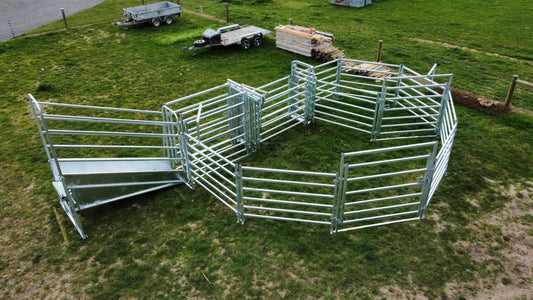
Not every operation is in a position to build new cattle yards from scratch. The good news is that a lot of these principles can be applied incrementally. Solid panels can often be added to existing rail systems. Lighting can be adjusted without structural changes. A curved race insert can sometimes be fitted where space allows.
The key is to start with the point in your system where cattle consistently baulk or pile up. That's usually where the most stress is concentrated, and it's often where a targeted change delivers the fastest return.
If you're not sure where that point is, spend a full muster watching what the cattle are responding to rather than trying to push them through it. You'll usually find the answer within a few minutes.
Handler Behaviour Is Part of the System
Yard design and handler technique aren't separate topics. They're part of the same system, and it's worth saying clearly: a well-designed yard makes it easier to handle cattle calmly, but it doesn't replace the handler.
Respecting the flight zone, moving at the right angle, and keeping noise and movement to a minimum are things no gate or panel can do for you. What good cattle yards design does is remove the environmental triggers that make calm handling almost impossible. It gives your technique room to actually work.
The Bottom Line
The difference between a 10-minute muster and a three-hour battle often comes down to one or two design details. Not the cattle. Not the dogs. Not bad luck.
If your yards are fighting you, it's worth asking honestly whether the problem is behavioural or structural. In our experience, it's structural far more often than farmers want to admit. And once you fix the structure, the cattle tend to sort themselves out.
That's not magic. That's just good design doing its job.
If you want to talk through what that looks like for your setup, flick us a message. We work with farms big and small, and there's always a Kiwi on the other end who knows what a hard muster actually feels like.