Sheep bolt. Cattle barge. And if your yard wasn't designed with both behaviours in mind from day one, you're going to spend years fighting your own infrastructure every single time you bring stock in.
This isn't a knock on farmers who've made it work with what they've got. Most mixed-stock farmers are incredibly resourceful. But there's a real difference between a yard that functions and a yard that works, and when you're running cattle and sheep through the same setup, that gap tends to show itself in ways that are expensive, exhausting, and occasionally dangerous.
Having talked with farmers across New Zealand, the pattern is consistent. The mistakes aren't random. They're predictable. And they almost always come back to one core problem: the yard was designed for one species, then adapted for the other, rather than built to serve both from the ground up.
Here's our take on what gets it wrong, and what actually makes a mixed-stock yard worth the investment.
The Behaviour Gap Nobody Talks About Enough
Cattle and sheep are fundamentally different animals to handle. Not just in size, but in how they move, how they respond to pressure, and how quickly a situation can escalate when they feel trapped or confused.
Cattle move slowly when they're settled. They respond to pressure in predictable arcs. They can be pushed, held, and turned if your yard gives them the visual cues and flow to do it. Their instinct is to follow the animal in front, which is why race design and forcing pen shape matter so much.
Sheep are different. They're faster, more erratic under stress, and far more likely to bunch hard into a corner rather than flow forward. They're also smaller, which means any gap in your rails, any low hinge point, any uneven footing in a race becomes a problem you didn't anticipate when you were thinking cattle-first.
Most single-species cattle yards are designed with exactly none of this in mind. Wide races, rail spacing that works fine for a 500kg Angus, forcing pens built for animals that respond to handler movement in a specific way. Then a sheep comes through and suddenly the race is too wide, the low rails are too far apart, and you're trying to draft lambs through infrastructure that was never meant to see them.
Designing for mixed stock means holding both animals in your head simultaneously, from the very first pen dimension on the plan.
The 7-Rail Advantage for Mixed-Stock Operations
One of the clearest practical upgrades a mixed-stock yard can have is panel and gate design with tight rail spacing at the bottom.
This is where a lot of older or lower-spec yards fall short. Standard cattle panels are often designed with the assumption that the smallest animal coming through weighs several hundred kilograms. Rail spacing that's perfectly fine for cattle becomes a serious problem when you're moving sheep, particularly lambs at weaning time.
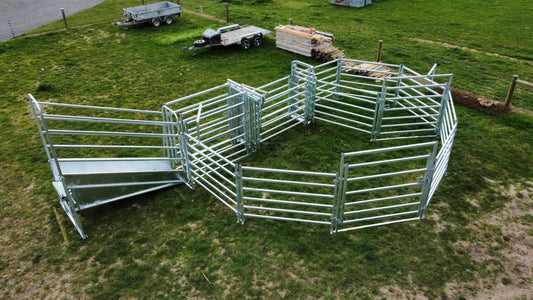
Our panels and gates in the new Onefarm range all run 7 rails, with rail spacing that tightens significantly toward the ground. The practical effect is that you get a much stronger visual barrier at lower heights, and sheep are far less likely to attempt a gap that a calf or small stock would ordinarily try to push through.
It's also worth noting that panel strength isn't just about the thickness of the steel. Our 47mm deep cattle rail resists lateral pressure better than thinner alternatives, because cattle push sideways, and depth is what handles that load. For a mixed-stock yard where you're potentially holding cattle hard against a gate while processing sheep in an adjacent pen, that kind of structural confidence matters.
The Short-Handed Problem
One of the most underappreciated challenges in mixed-stock yard design is how much it asks of the people running it.
Cattle and sheep don't always cooperate on a shared schedule, and most mixed-stock operations aren't running with a full crew. If your yard design requires three people to draft effectively, you've got a problem on any day when only two show up. If reconfiguring between species takes 45 minutes, that time comes from somewhere, usually from the end of a day that was already long.
Good mixed-stock yard design thinks about handler movement. It thinks about where one person needs to stand to control both the forcing pen and the draft gates. It thinks about sight lines, about whether you can see the race from the drafting point, and about whether the natural flow of both species gives you any margin for short-handed operation.
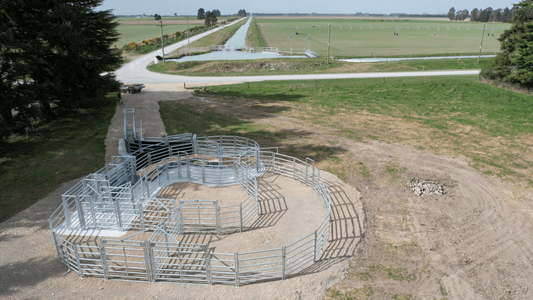
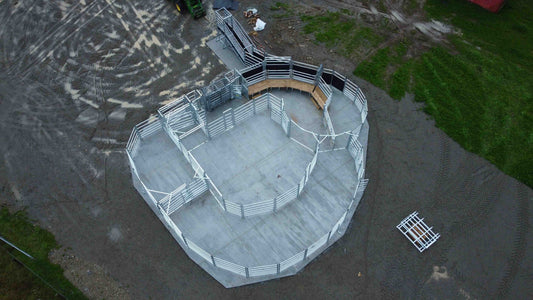
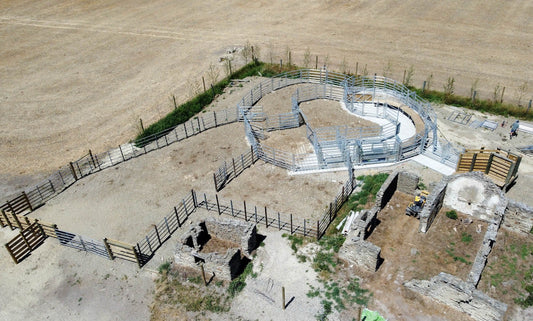
This is where circular or curved race design, drawing on the kind of low-stress livestock handling principles that Temple Grandin made famous, starts to pay real dividends. Curved races work with the natural follow behaviour of both cattle and sheep better than straight ones. And a forcing pen with the right dimensions means animals move forward without needing someone constantly pushing from behind.
These aren't fancy extras. For a mixed-stock operation with limited labour, they're the difference between a yard that one person can run effectively and one that requires backup every time.
The Financial Reality of Getting It Wrong
Yards are a capital decision that most farms live with for a generation. Built well, a yard adds to the value of a property and shapes how it operates every year for decades. Built as a compromise, it accumulates cost in ways that aren't always obvious until you add them up.
Reconfiguration time is cost. Stress-related stock losses are cost. Handler injuries from working in an undersized or poorly laid out yard are cost. And the temptation to keep patching a yard that doesn't quite work rather than addressing the fundamental design problem is one of the most common traps we see.
The farmers who've done this well, who've built mixed-stock yards that genuinely hold up over time, are consistent about one thing. They spent more time on the design phase than they expected to. They asked hard questions about stock flow before a single post went in. And they designed for the way they actually work, not the way they imagined they'd work.
If you're on the fence about whether a dedicated mixed-stock layout is worth the investment, the honest answer is: the upfront cost of designing it right is almost always less than the long-term cost of designing it wrong.
Before You Pour a Post
Mixed-stock yard design is one of the more complex conversations we have with farmers, and it's one we genuinely enjoy. The variables are real, the trade-offs are honest, and there's usually a smarter configuration available than the first one on the plan.
If you're at the stage of thinking through a yard that needs to handle both cattle and sheep, flick us a message. There's a Kiwi on the other end who's had this conversation many times before, and we're happy to work through what would actually suit your operation.
Getting it right from the start is worth every minute of the planning.