Most farmers get this decision wrong the first time. Not because they don't know their operation, but because they're thinking about where they are right now instead of where they'll be in ten years.
Permanent yards feel like the responsible choice. Solid. Professional. Built to last. But pour the concrete before you've thought it through properly, and you've locked yourself into a setup that may not suit your land, your herd size, or your plans for the future.
That's an expensive mistake to live with.
So let's talk through this properly. Not a generic buying guide, but an honest look at what each option actually means for the kind of operators we work with every day here at Onefarm.
The Real Question Isn't Permanent vs. Portable
Here's what most of the content on this topic gets wrong: it treats "portable" as meaning yards that get dragged around the paddock every couple of weeks. That's not what we're talking about.
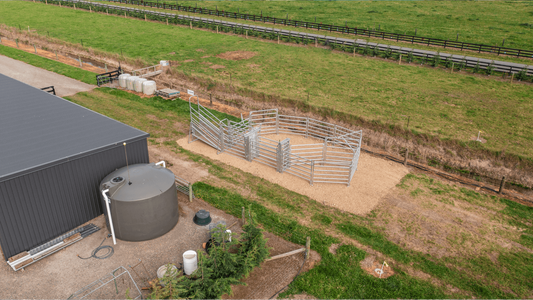
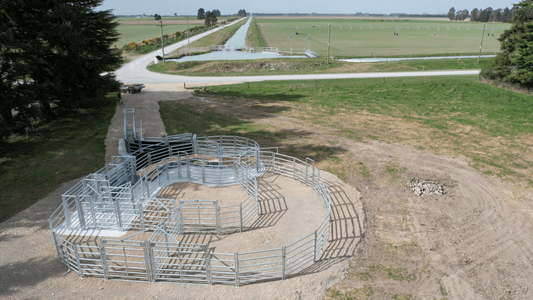
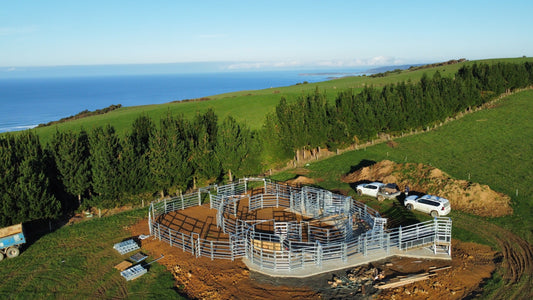
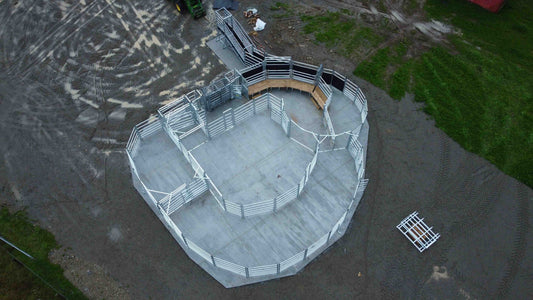
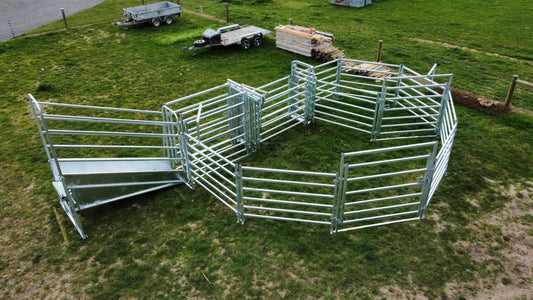
When we say modular and relocatable yards, we mean a system that can be dismantled, transported, and reinstalled properly. A system you can start small with and add to over time. A system you can take with you if you sell the farm, expand your block, or need to shift your working area entirely.
That's a fundamentally different conversation from asking whether permanent concrete-and-steel infrastructure is better than a temporary setup.
It's not temporary portability vs. permanence. It's long-term adaptability vs. fixed infrastructure. And that framing changes everything.
Why Permanent Yards Make Sense for Some Operations
Let's be fair. Permanent yards have real advantages and they're the right call for plenty of operations.
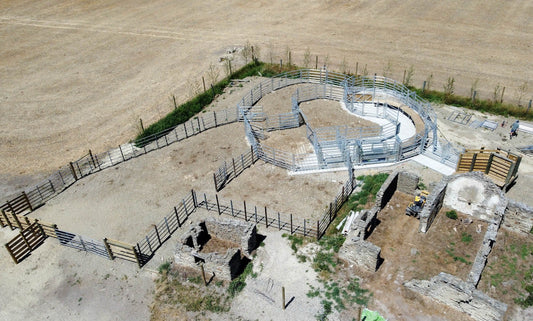
If you're running hundreds or thousands of head through the same fixed site year in and year out, and that site isn't changing, a fully permanent setup often delivers the best long-term workflow. You can engineer the race layout precisely to your land contours, pour hardstanding for effluent management, and build in loading infrastructure that's spec'd to your specific trucks.
For large commercial operations on owned land with a stable long-term plan, permanent infrastructure is often worth every dollar.
But here's the thing about permanence: it cuts both ways.
Fixed yards are difficult to modify. If your operation grows, if your crush position needs to shift, if your race layout isn't working the way you hoped, you're either living with it or spending money you didn't plan to spend. That's not a hypothetical. We hear this from farmers regularly. The first set of yards they inherited or installed years ago is now a constraint rather than an asset.
Where Modular Yards Win, and Why It Matters More Than You Think
The case for a modular, relocatable yard system isn't just about flexibility in the abstract. It comes down to a few very specific situations where fixed infrastructure genuinely works against you.
You're still building your operation. If your herd is growing or you're not yet sure where your permanent working area will sit, investing in fixed infrastructure before you have that clarity is a risk you don't need to take. A modular system lets you start with what you need now and add sections as the operation grows. That might mean starting with a 27-head yard and scaling up to a 100-head system over several seasons. You're building value incrementally rather than making one large bet on a layout that's difficult to change.
You're on leased or agisted land. This is a situation that gets almost no attention in the standard buying guides, which is strange because it affects a significant number of operators. If you don't own the land your yards are on, permanent infrastructure either becomes a gift to the landlord or a negotiation point in your lease. A quality modular system is your asset. It moves when you move.
You want to shift the working area on your own property. Properties change. New laneways get put in. Grazing systems evolve. Effluent management requirements tighten up. What was a logical working area five years ago might not be where you'd place the yards if you were starting fresh today. Permanent infrastructure doesn't give you the option to reconsider. Modular yards do.
You're planning to sell. Permanent yards add value to a property, but that value is baked into the sale price whether the buyer wants that specific setup or not. Modular yards are a moveable asset. You can take them with you, add them to your asking price as a negotiable item, or sell them separately. That's optionality that fixed infrastructure simply doesn't offer.
The Cost Conversation Nobody's Having Honestly
There's a tendency to compare upfront purchase prices and call it analysis. It's not.
The honest comparison is total cost of ownership across ten to twenty years, including maintenance, any relocation or modification costs, and opportunity cost if the infrastructure ends up in the wrong place or the wrong configuration.
Permanent yards, once in, are in. If the layout isn't working efficiently, you're losing time every single time you work cattle. Labour inefficiency is invisible in a cost comparison spreadsheet but it's very visible on a long working day.
Modular yards built from quality materials, hot-dipped galvanised steel with a rail profile that's actually engineered for lateral cattle pressure, will hold up for decades. The durability argument for permanent infrastructure doesn't hold the way it used to when the alternative is a well-built modular system. These aren't lightweight temporary panels. They're proper yards that happen to be designed with adaptability in mind.
At Onefarm, our 47mm deep cattle rail is 15% stronger than most alternatives because of how cattle actually apply pressure, laterally, not downwardly. Rail profile depth is what resists that load. That's an engineering decision, not a marketing point. And it means our modular yards aren't a compromise on strength. They're built to the same standard you'd expect from fixed infrastructure.
A Decision Framework, Based on Your Situation
Rather than a blanket recommendation, here are the honest signals that point toward each option.
Lean toward permanent if:
- You own the land and have no plans to change its use
- You're running consistent high volumes through a fixed site
- Your working area is already optimised and you're not anticipating layout changes
- You have the capital and the certainty to justify it
Lean toward modular if:
- You're still growing the herd and aren't sure what the operation looks like at full scale
- You're on leased or agisted land
- Your property layout has changed or is likely to change
- You want the asset to remain yours regardless of what happens with the land
- You're starting out and want to invest in stages rather than all at once
- You want the option to expand, reconfigure, or relocate without starting from scratch
There's also a third path worth mentioning: running both. A number of the operators we work with have a permanent working setup at their main site and a modular system for a second block or a remote area of the property. That's not a compromise. For some operations it's actually the most efficient model going.
The Setup You'll Still Be Happy With in a Decade
The biggest mistake isn't choosing the wrong type of yard. It's making the decision based on what you need right now without accounting for how much operations change over a ten or fifteen year horizon.
Herd sizes grow. Farms get sold and bought. Lease arrangements end. Grazing systems evolve. Land-use regulations shift. The infrastructure that serves you best long-term is the infrastructure that gives you options, not the infrastructure that locks you in because it felt like the safe call at the time.
If you're working through this decision for your own operation and want to talk it through with someone who knows cattle yards properly, flick us a message. There's a real person on the other end who's had this conversation with farmers from Kaitaia to Bluff, and we're happy to help you think it through before you spend a cent.