Most processing days go wrong in the same place. Not at the crush. Not at the loading ramp. It's the ten feet before all of that where things fall apart. Animals stall, circle back, and suddenly, what should have been a straightforward working day turns into a two-hour wrestle with your own cattle.
That's almost always a forcing pen problem.
We've seen it enough times to say it plainly: a lot of farmers are running good yards with a forcing pen that's either poorly designed, poorly used, or both. And the thing is, fixing it doesn't require pulling everything apart and starting again. It usually comes down to understanding what the forcing pen is actually supposed to do and then using it accordingly.
So here's our take on it.
What the Forcing Pen Is Actually For
At its core, the forcing pen has one job: move animals forward into the race in a calm, controlled way with as little handler effort as possible.
That's it. It's not a holding area. It's not somewhere to park a mob while you sort something else out. It's a funnel, and like any funnel, it only works when the geometry and the flow are right.
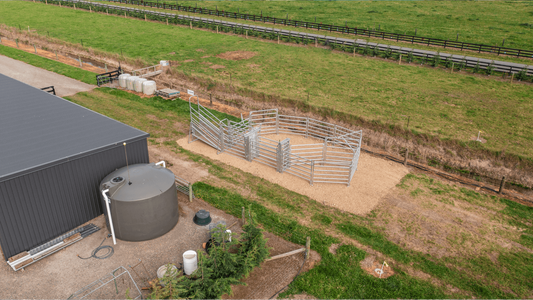
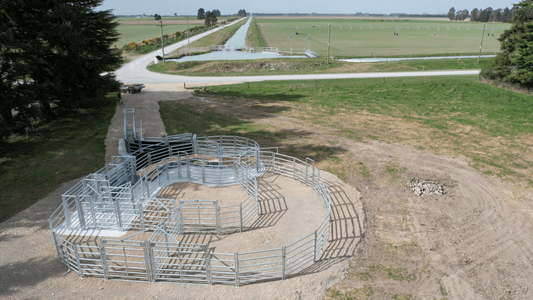
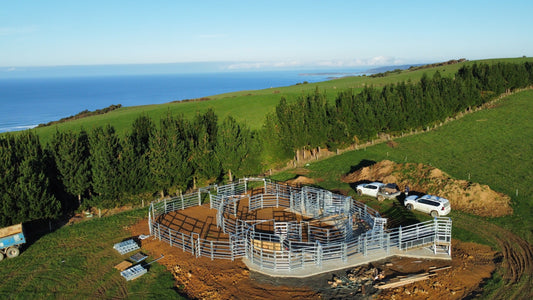
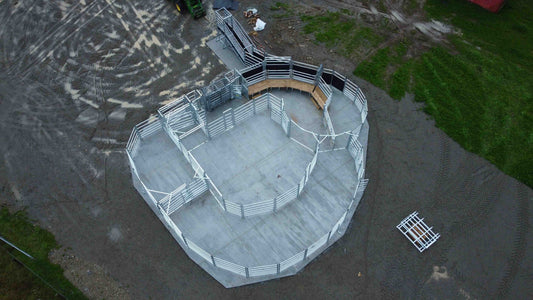
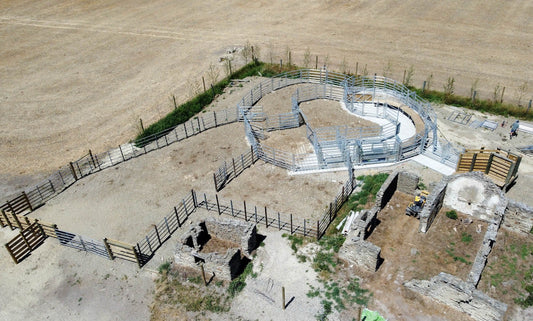
The circular design, which we use in our yards, is built around the way cattle naturally move. They don't like corners. They don't like dead ends. A curved forcing pen with a curved crowd gate lets animals keep walking in a consistent arc rather than piling up against a flat wall and stopping. The result is a pen that loads itself, more or less, when you work it properly.
That last part matters when you work it properly.
The Crowd Gate Is Not a Shovel
Here's where a lot of handlers go wrong.
The crowd gate in a circular forcing pen is designed to close the arc behind the animals as they move forward, reducing the space behind them and keeping forward momentum going. It's a pressure tool, but a gentle one. Think of it as a slow, steady squeeze rather than a hard push.
When farmers use the crowd gate like a shovel, forcing it into the animals aggressively, the opposite happens. Cattle bunch, they panic slightly, and the animals at the front start pushing back against the ones behind rather than stepping forward into the race. You've created a pressure cooker rather than a flow system.
The correct technique is to move the gate in small increments. Allow a gap. Let the animals shift before you close the gap further. If they stop, pause. Give them a moment to settle and read the space ahead. Then move the gate again.
Patient gate work cuts handling time more reliably than aggressive gate work every single time.
Handler Position Changes Everything
You can have the best circular forcing pen in the country and still fight your cattle if you're standing in the wrong spot.
Inside a circular pen, your position relative to the animals' flight zone determines whether they move forward or circle back toward you. The flight zone is the bubble of space around each animal that, when you enter it, causes them to move. Get into it from behind the shoulder, and they'll move away from you, which is forward. Step in front of the shoulder, or get too far to the side, and they'll turn and face you.
In a circular forcing pen, the handler should generally be working from outside the pen or from a low-stress position at the rear quarter of the mob. You're not in there herding them. You're applying steady, directional pressure that channels where they already want to go.
This is the part that doesn't come with the pen itself. It's a skill, and it takes a few working days to develop. But once you've got it, the difference is immediate. You'll cover the same ground with half the noise and a fraction of the energy.
Pen Fill Matters More Than Most Farmers Realise
There's a common instinct to pack the forcing pen as full as possible before starting. More animals in, more animals through, done faster. In practice, overfilling the pen creates exactly the chaos you're trying to avoid.
A forcing pen that's too full gives the animals nowhere to flow. They stand still because they physically can't move forward, and then they start to stress as the pressure behind them builds. You end up fighting a packed pen rather than working a moving one.
The general rule we'd offer is to fill to roughly two-thirds capacity. Enough animals to create natural forward movement and pressure, but enough space that the mob can actually flow through the curve. You'll process faster with a pen that's moving than with one that's jammed, every time.
It also makes a real difference to the animals themselves. Less pressure, less contact with the fence, less bruising. That matters for carcass quality, and it matters for the working environment for your team.
When Animals Refuse to Enter the Pen
This one catches farmers off guard, especially when they've got good infrastructure. If cattle are refusing to enter the forcing pen at all, the instinct is to push harder. But that usually makes it worse.
Refusal to enter is almost always a sensory issue. Cattle are sensitive to light contrast, shadows, and unfamiliar surfaces underfoot. If the forcing pen entry is heavily shaded compared to the yard behind it, animals will hesitate because they can't clearly see what they're walking into. It reads as a threat, or at minimum, as unknown territory.
Worth checking: is the entry well-lit? Is there a shadow line across the entrance that lines up with the animals' eye height? Is the floor surface different from what they've been walking on? Small adjustments to any of these can make a genuine difference to pen entry rates.
Noise is another one. Banging gates, clanking metal, any unnecessary movement from handlers near the entry point all make cattle more reluctant. A calm, quiet entry moment is more effective than any amount of encouraging noise.
The Circular Pen vs. The Square Pen
We make no secret of the fact that we prefer the circular forcing pen. Not because it's newer, but because it genuinely works better for how cattle move.
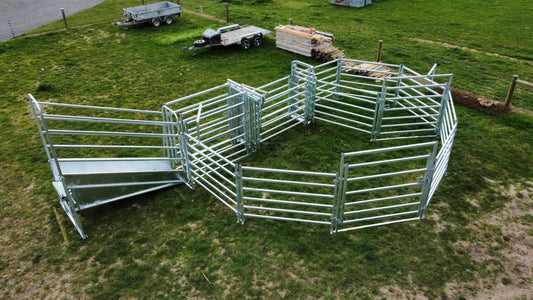
A square or rectangular forcing pen with a flat crowd gate can work. Plenty of well-run operations use them. But they require more precise gate angles to achieve smooth flow, and corners create natural stopping points where animals bunch and stall. The handler has to do more work to keep things moving.
The circular design removes most of those stall points. The curve keeps the mob oriented in the same direction, and the curved crowd gate closes in a way that naturally directs animals forward rather than sideways. Less handler effort for the same result.
That said, if you're running a portable or temporary setup and a circular pen isn't practical, the fundamentals still apply. Smooth entry, controlled crowd gate movement, good handler position, and the right pen fill will improve any forcing pen configuration.
It's Not the Cattle. It's the Setup.
We'll say this clearly because it bears saying: if your processing days are consistently chaotic, the cattle probably aren't the problem.
Cattle are predictable when the conditions are right. They follow pressure, they move along curves, they go toward light and away from confinement. A forcing pen that's designed and used to work with those instincts will run as it should. One that works against them will fight you every single working day.
Getting the forcing pen right is one of the highest-return things you can do in your yards. Not because it's complicated, but because it's the piece most farmers underestimate.
If you want to talk through your setup, whether you're planning new yards or trying to get more out of what you've already got, flick us a message. There's a Kiwi on the other end who knows this stuff and is happy to help.