Most farmers design their yards around the cattle. The smart ones design them around the weather first.
That might sound backwards. But if you've ever tried to work a mob through a yard that turns into a bog after a week of Northland rain, or watched a poorly sited yard on a Hawke's Bay hillside become a drainage nightmare, you'll know exactly what we mean. Cattle yards design in NZ isn't a one-size-fits-all exercise. Your climate, your terrain, and your prevailing conditions are just as important as the gate configuration and the forcing pen layout.
Here's our honest opinion on why so many yards underperform, and what to think about before you pour a post or bolt a rail.
Mud is Not Just a Nuisance. It's a Profitability Problem.
Let's be direct about mud. It's not just inconvenient. Mud in a cattle yard costs you in livestock condition, in handling time, in stress on your animals, and in biosecurity risk. Cattle standing in it for hours while you're working through a mob are losing condition they'll need weeks to recover. That's real money.
And yet, drainage is still one of the most overlooked elements of yard planning in NZ. Farmers spend weeks thinking about which crush to buy and not enough time thinking about where water goes when it rains.
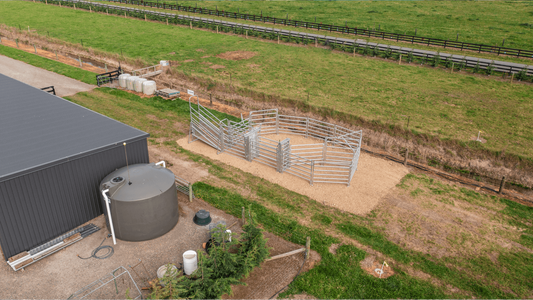
The ground surface inside your yards, and the slope of that surface, is fundamental. A well-designed yard should shed water quickly and cleanly. In high-rainfall regions like Northland, the Waikato, or the West Coast, this means thinking hard about your site before anything else. Concrete or compacted gravel that drains toward the perimeter. Falls of at least 1 in 50. Sumps or cut-off drains to redirect surface runoff. These aren't fancy extras. They're the baseline for a yard that doesn't fight you every wet winter.
What Works in the Waikato Won't Work in Marlborough
New Zealand is a small country with wildly different climates packed in close together. That regional variation matters more than most farmers account for.
In Northland and the Waikato, rainfall is your primary enemy. High annual rainfall, heavy clay soils, and mild temperatures that keep the ground soft for most of the year mean drainage and surface stability are non-negotiable yard design priorities. If your yard isn't properly surfaced and sited on well-drained ground, you'll be fighting mud for eight months of the year.
Move south to Marlborough and Central Otago and the problem almost reverses. Hot, dry summers, strong nor'westers, and significant temperature swings create different stresses. Here, shade and wind shelter become more important than most people expect. Cattle working through exposed yards in 35-degree Canterbury heat or howling nor'wester conditions are stressed animals. Stressed animals are harder to handle, and harder handling means slower work and higher injury risk.
In Southland, it's cold. Wind chill, wet winters, and frosts that linger well into spring mean that your materials choice matters a great deal. Galvanised steel handles New Zealand's climate well across the board, which is one of the reasons we hot-dip galvanise our yards. But in the south especially, you want to know your infrastructure can handle decades of that punishment without corroding or weakening.
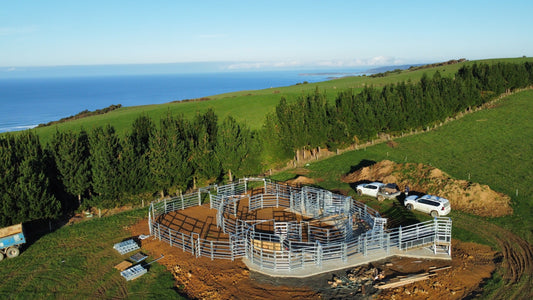
Coastal farms bring another factor: salt air accelerates corrosion on any exposed metalwork that isn't properly treated. We've worked with farmers on exposed South Island coastline, including Cameron Clark's 186 head commercial yard on the southeastern coast, where the site context was spectacular but the environment was genuinely demanding. The right materials and the right finish aren't optional in those conditions.
Terrain Changes Everything
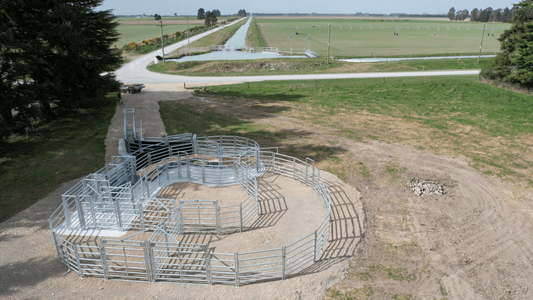
Flat land farmers have it easier in some ways. Siting a yard on flat, well-drained ground gives you maximum flexibility on orientation and layout. You can think purely about stock flow, sun angle, prevailing wind, and access without fighting the topography.
Hill country is a different conversation entirely.
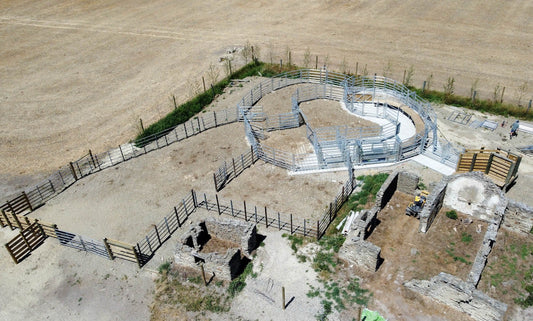
On a steep or rolling property, you're often working with the terrain rather than ignoring it. That's actually an advantage if you use it well. Natural slopes can eliminate the need for a raised loading ramp, saving you cost and complexity. A cut-and-fill site can create a level working platform while giving you a built-in loading height at the bank edge. We've seen this done well on sheep and beef hill country farms across the North Island where the terrain ended up being a genuine design asset.
But slope creates real problems if you get the siting wrong. A yard positioned at the bottom of a catchment will collect every drop of runoff from above. A yard facing into the prevailing weather will expose your animals and your team to the worst conditions on site. A yard on unstable or wet subsoil will move and settle in ways that compromise gate alignment and overall function over time.
On hilly terrain, ground investigation before you design is not optional. Know your subsoil. Know where the water goes after heavy rain. Know which direction the wind comes from on a bad day. These things should be driving your yard placement, not just your access track location.
Sun and Wind: The Two Factors That Get Ignored
Orientation is one of those details that rarely makes it into conversations about cattle yard design in NZ, but it matters more than most people think.
A yard that faces into the afternoon sun in summer creates a miserable working environment for both cattle and the people handling them. Cattle become more agitated and reactive in direct sun and heat. Your team is working in harder conditions for longer. Simple orientation choices, keeping the main working race running north-south to minimise direct afternoon sun on the cattle, can meaningfully reduce handling stress.
Wind is the same story. If your forcing pen is oriented so that cattle are pushing into a strong prevailing wind, you'll have harder work getting them moving. If your yard is exposed on a ridge with no shelter, every muster in winter becomes a battle. Positioning windbreaks, whether planted shelter belts or solid panels, on the windward side of your yard is a straightforward improvement that makes a real difference to how the yard works on a bad day.
These aren't complicated considerations. But they're consistently the ones farmers tell us they wish they'd thought about before committing to a site.
Small Operations Aren't Exempt From These Principles
One thing worth saying clearly: these factors don't only apply to large commercial operations. A lifestyle block with 20 to 30 head has the same exposure to rain, mud, wind, and difficult terrain as a 500-head beef unit. The scale is different. The principles aren't.
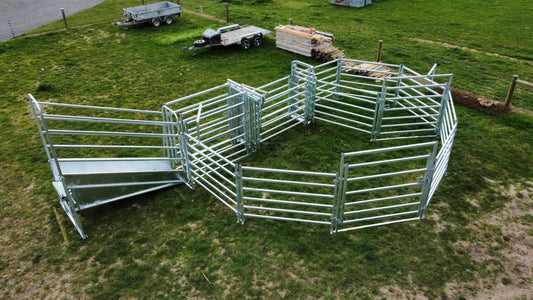
Our MAXXUS range is built specifically for smaller operators, including lifestyle block farmers who are often overlooked when this kind of infrastructure conversation happens. But whether you're running a MAXXUS 20 Head Yard on a 10-acre block or a COMMERCIAL 186 Head Yard across a hill country station, getting the site right matters equally. A poorly sited small yard is just as frustrating to work in as a poorly sited large one. Sometimes more so, because on a smaller property you have fewer options to compensate.
Getting the Design Right Before You Commit
None of this is meant to make yard planning feel overwhelming. It's meant to make sure you're asking the right questions before you commit money and concrete to a site.
Where does your water go after 100mm of rain in 24 hours? What direction does your worst weather come from? Is your proposed site going to be workable in the middle of a wet winter muster? Is there a loading height advantage in your terrain that you could use rather than engineer around?
If you're not sure of the answers, the right move is to talk it through before you finalise anything. We work with farmers across New Zealand, from Kaitaia to Bluff, on exactly these kinds of questions. There's always a Kiwi on the other end of the phone or email, and we're genuinely happy to think through site options with you before you make any decisions.
Flick us a message. It's the kind of conversation that pays off for years.