Cattle baulking in the yards costs you time, money, and nerves. Here's what's actually causing it and the design fixes that get stock flowing.
Your mob moves well in the paddock. They follow routine, they respect the dogs, they shift without much fuss. Then they hit the yards, and it all falls apart.
One animal stops. The ones behind bunch up. You push a little harder. Nothing. Then someone tries to squeeze through a gap, and things get unpredictable fast.
If that sounds familiar, you're not alone. And more importantly, it's not your stockmanship. It's your yard design.
Cattle Don't Baulk Without a Reason
Cattle are prey animals. Their entire nervous system is wired to detect threats and avoid them. When something in the environment reads as dangerous, they stop, back up, or try to turn around. They're not being difficult. They're doing exactly what evolution designed them to do.
The problem is that most yard layouts are built around what's convenient for the farmer to construct, not what makes biological sense to the animal moving through it. Sharp corners, sudden light changes, dead ends that look like traps, noise that echoes off steel panels, shadows that could be hiding anything. To a 500-kilogram animal running on instinct, these aren't just inconveniences. They're reasons to refuse.
Every time that refusal happens, you lose time. You risk injury to your animals and your crew. And you burn energy on pressure that wouldn't be necessary if the flow was right in the first place.
The Flight Zone and Why It Matters
Before we get into specific design fixes, it helps to understand one core principle: the flight zone.
Every animal has an invisible boundary around it. Cross that boundary and the animal moves away from you. Work the edges of it, and you can direct movement calmly and efficiently. Blow through it too hard, and you trigger panic.
Good yard design works with the flight zone rather than against it. It creates a path of least resistance where cattle feel like moving forward is their idea, not something being forced on them.
Temple Grandin's research on animal behaviour has been shaping yard design for decades, and the central insight holds as true today as it ever did: cattle that are stressed move unpredictably, and cattle that move unpredictably cause problems for everyone in the yard.
So what does that mean in practical terms? Here are the most common design faults that cause baulking, and what you can do about them.
Straight Races Are Working Against You
A long, straight race gives cattle a clear view of what's ahead. You might think that's a good thing. It isn't.
When an animal at the back of a race can see all the way to the crush or the end of the run, it can also see every obstacle, every handler, every shadow. If anything looks threatening at that end, the whole mob reads it and refuses to enter.
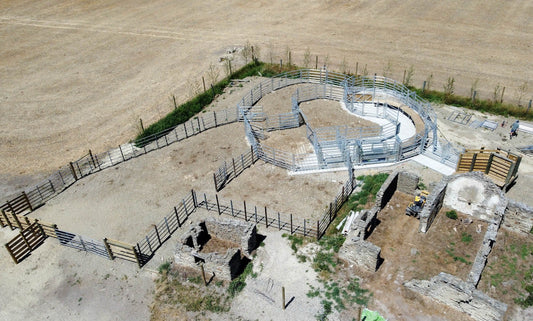
Curved races remove that line of sight. Cattle can only see a few body lengths ahead, which means they stay curious and keep moving forward rather than locking up at the sight of something at the far end. A gentle curve, not a tight bend, is what you're after. Tight bends create their own problems by encouraging animals to try and turn around.
If you're working with an existing straight race and a full redesign isn't on the cards right now, even adding a slight dog-leg to break the sightline can make a difference.
Forcing Pens That Actually Force the Issue
The forcing pen is where most baulking begins. If it's square, if the angles are too sharp, or if cattle can see the exit and decide they don't like the look of it, you'll fight them every time.
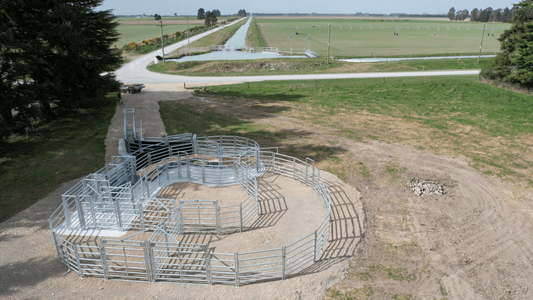
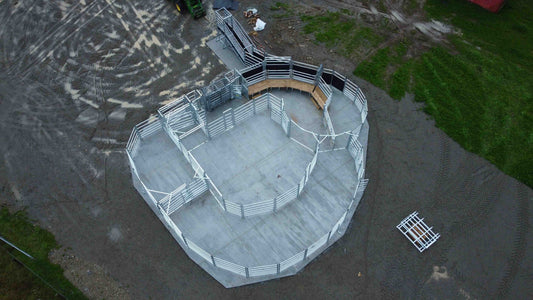
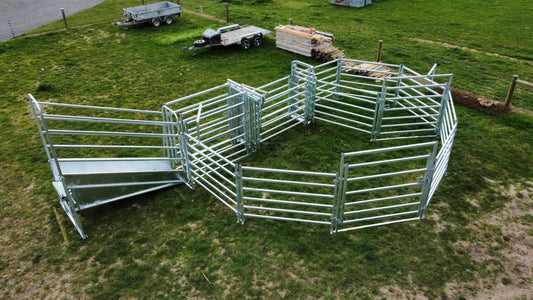
A circular forcing pen is a significantly better design. Cattle move around the curve naturally, and because the exit into the race is set at an angle, they flow into it rather than confronting it head-on. There's no corner to back into, no dead end to spook at.
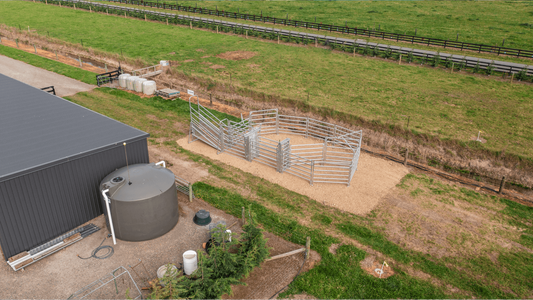
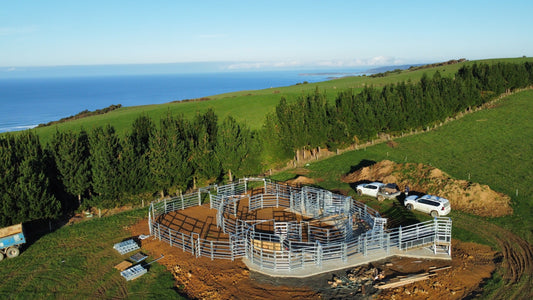
Onefarm's yard configurations include the option for a circular no-trip forcing pen precisely because this isn't a marginal improvement. It's a fundamentally better way to move cattle. Farmers who switch from square to circular consistently report calmer, faster throughput and fewer incidents.
Light and Shadow Are Silently Causing Problems
This one surprises a lot of farmers the first time they hear it, but once you know it, you can't unsee it.
Cattle will not willingly walk into a shadow if they can avoid it. To their eyes, a sharp shadow across a race entry or a darkened crush area looks exactly like a hole in the ground or an unknown obstacle. Their instinct says "Don't step in it."
A few common situations where this bites farmers:
- Morning sun throwing long shadows across the forcing pen entry.
- A solid roof over the crush area that makes it significantly darker than the race leading into it.
- Gaps in panel work that create bars of light and shadow across the floor.
The fix is often simpler than you'd expect. Adjust the orientation of your yards when you're planning the build so that your main working direction doesn't point directly into the rising or setting sun. Consider where your panels are solid versus open, and think about what that does to the light at floor level.
If you're working with an existing setup, try running cattle at a different time of day and see whether it changes anything. You might find you've been fighting shadows, not attitude.
Noise Is a Bigger Deal Than Most Yards Account For
Steel yards can be loud. Rails rattle, gates clang, panels vibrate. Every sharp noise in an enclosed yard space spikes an animal's stress and makes the next animal less willing to come in.
Some of this is just the nature of working yards. But a lot of it comes down to build quality and design. Rails that fit properly, pins that seat cleanly, hinges that don't grind, gate latches that close without a bang. These details matter not just for longevity but for behaviour.
Anti-rattle clamps, solid ground anchoring that stops panels flexing and vibrating, and well-fitted components that don't rattle loose over time are all worth factoring into your decision when you're choosing a yard. A yard that goes quiet when it's supposed to be quiet is a yard that helps you, not one you're working against.
What You're Actually Standing On Matters Too
Cattle are acutely sensitive to footing. Slippery surfaces, uneven concrete, or surfaces that feel unstable underfoot will cause an animal to brace, back up, or refuse. This is particularly true at the crush entry and on loading ramps, where animals are already in a heightened state.
When Onefarm builds loading ramps into yard configurations, the surface specification is part of the conversation, not an afterthought.
Handler Position Is Part of the System
Yard design gets most of the attention in conversations about baulking, and rightly so. But it's worth acknowledging that the design and the handler work together as a single system.
Even the best-designed yards can produce baulking if handlers are positioned in the wrong place. Standing directly in an animal's line of sight, applying pressure from the wrong angle, or being too visible through open panel work will override the advantages of good design.
A yard that provides solid panel work in the right places gives handlers the ability to move in and out of the flight zone without being fully visible to approaching cattle. That's not just about safety, though it helps there too. It's about being able to work the mob without advertising your position to every animal in the race.
Think about where your panels are solid and where they're open when you're planning or auditing your layout. Solid panels on the inside of curves, open panels where you need to see in and intervene safely. That balance is worth getting right.
Auditing Your Own Yards
One of the most useful things you can do is observe your yards in use from a vantage point you don't normally use. Get up on the fence. Use a phone or a camera on a post. Walk the race yourself at animal height; literally crouch down and look at what an animal sees as it enters.
You'll often spot things that are invisible from a normal working position. A shadow you'd never noticed. A gap in the panel work that gives a view of something distracting. A gate left open at the wrong angle that creates a visual dead end.
This kind of audit doesn't cost anything, and it can identify changes you can make without pulling anything apart.
When the Design Itself Is the Limit
Sometimes the audit makes it clear that incremental fixes aren't going to be enough. The layout is too straight, the forcing pen is the wrong shape, the orientation is fighting the sun. At that point, the conversation shifts to what a rebuild or a new installation would actually cost versus what you're losing every time cattle work blows out.
If you're at that point, or if you're putting in new yards and want to get the design right from the start, that's the conversation Onefarm is set up for. Our yards are designed with flow in mind, from the circular forcing pen option through to the panel configurations and ramp specs. We're not just selling steel. We're thinking about how cattle move through it.
Flick us a message or give us a call on 0800 ONEFARM.