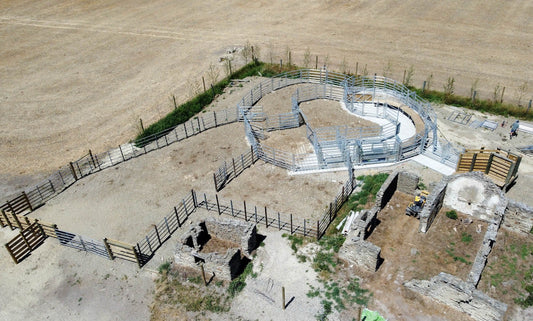
The shape of your yards could be costing you thousands of dollars every season. Not because of what breaks down or wears out, but simply because of the way cattle move through them.
If you've ever had a muster run two hours over time, watched stock baulk at a corner, or needed three people to do a job that should take one, the design of your yards is worth looking at seriously. Because circular cattle yards efficiency isn't a theoretical concept. It's something farmers across New Zealand are putting a dollar figure on, season after season.
Here's what the research says, what experienced handlers know, and what it might actually be worth to you.
Why Cattle Don't Move Well Through Square Corners
Cattle have wide-angle vision. They see almost all the way around themselves without turning their heads. And what they don't like is anything that looks like a dead end.
When a beast reaches a square corner in a traditional straight-race yard, it sees a wall. Its instinct is to stop, turn, or back up. That hesitation is where your time goes. It's also where your workers end up having to push harder, move faster, and take more risk.
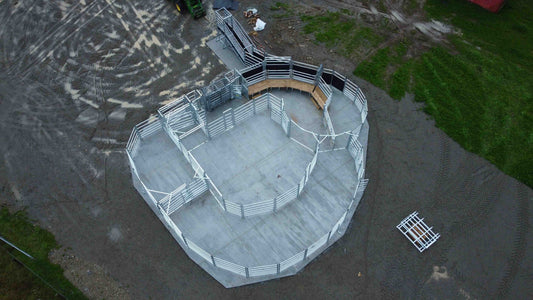
A curved or circular yard removes that visual obstruction entirely. As cattle move forward, they can see the path continuing ahead of them. There's nothing to trigger the stop response. They keep walking.
This isn't a new idea. Livestock handling researcher Temple Grandin has spent decades documenting how curved races and circular forcing pens reduce the need for physical pressure during handling. Her findings have influenced yard design internationally, and for good reason. The geometry works with how cattle naturally behave, rather than against it.
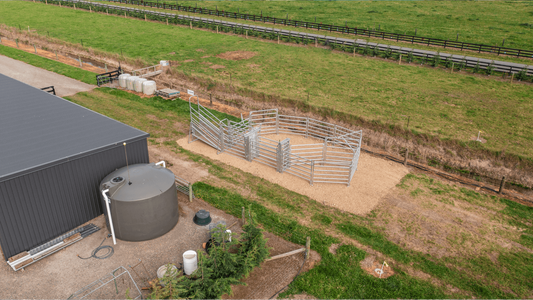
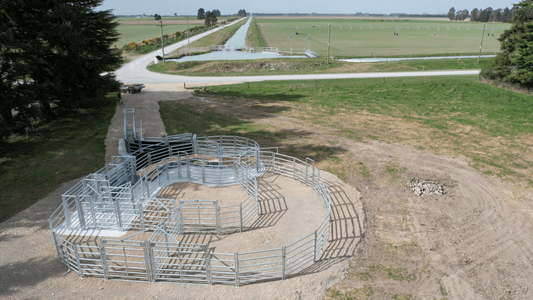
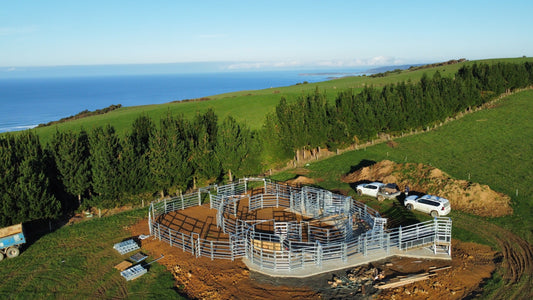
What Circular Cattle Yards Look Like in Practice
Faster flow through a yard sounds good in principle. But what does it actually mean when you're working cattle on a Tuesday morning with a list of jobs still ahead of you?
Consider a farm running 300 head through a drafting and processing session. With a traditional straight-race setup, that work might take a full day, with regular stoppages, restarts, and a fair bit of pushing from handlers. With a circular system, many farmers report processing the same number of cattle in significantly less time. The cattle move more calmly, they load into the race more willingly, and the handlers spend less energy.
Less energy from handlers means fewer mistakes. Fewer mistakes mean fewer injuries to stock and to people.
And time, of course, is money. If you're paying casual labour for an eight-hour day when the job could be done in five, that's a real cost. If a vet or contractor is on-site waiting on slow-moving stock, that's a real cost. If your staff are physically spent by midday and decision-making suffers in the afternoon, that's a real cost too.
Circular yard designs address all of those costs at the same time, without requiring you to change how you manage your farm.
The Forcing Pen Is Where Most of the Gains Come From
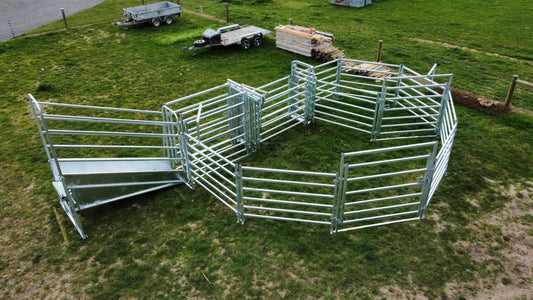
When people talk about circular cattle yards, they're often referring to the forcing pen specifically. This is the holding area that funnels cattle into the race. It's the transition point between the paddock and the crush, and it's where most traditional yards lose time.
A circular forcing pen works because it has no corners. Cattle in a standard square pen naturally drift into the corners and pack there. Getting them moving again means getting in behind them, which brings pressure, noise, and stress into the situation.
In a circular pen, cattle move around the perimeter. They stay in motion. When the gate opens to the race, they're already moving in the right direction. You're not creating flow. You're simply not interrupting it.
At Onefarm, our yards are designed with this principle built in. The circular no-trip forcing pen is a standard part of our Commercial range, and it's not an add-on or an upgrade. It's there because it works.
Is a Circular Yard Only for Large Operations?
This is a common assumption, and it's worth addressing directly.
Circular forcing pen systems are often associated with large commercial operations handling thousands of head. But the efficiency gains scale down just as well as they scale up. If you're a smaller farmer running 50 to 150 head, the time and effort savings per session are proportionally just as significant.
The difference is that on a smaller operation, the person spending extra time pushing reluctant cattle through a square-cornered yard is often the owner. It's your Saturday. It's your back. That's worth something.
Putting a Number on It
The ROI on circular yard design is real, but it's different for every operation. Here's a simple way to think about it.
Add up the hours your team spends handling cattle over the course of a season. Include the difficult sessions, the sessions that run long, the ones where you've needed more hands than usual. Then estimate a realistic hourly rate for that labour.
Now ask: if a different yard configuration reduced that time by 20%, what's that worth per season? Over five years?
For many farmers, even a conservative estimate puts the payback period for a well-designed yard well within a few seasons of regular use. And that's before factoring in reduced stock injuries, reduced worker strain, and the simple value of finishing a hard job in good time.
We'll be upfront about something. No yard design eliminates difficulty entirely. Cattle are cattle. But a circular system consistently gives you better odds of a clean, fast session, and over time, that compounds.
Ready to Talk Through Your Setup?
If your current yards are slowing you down, or you're building from scratch and want to get the design right the first time, we'd like to help.
Flick us a message or call us on 0800 ONEFARM. For farms big and small, the right yard design pays for itself. Let's figure out what that looks like for yours.